20' Sea Container & Curtainsider Truck Payload Optimization Guide for Fibre Cement Export from Türkiye
Because autoclaved fibre cement is a dense mineral product (~1.30–1.55 g/cm³), export shipments hit legal payload weight caps long before filling cubic container or trailer volume. Minimizing landed freight per m² from Türkiye requires booking 20' Heavy-Tested containers for flat boards, reserving 40' HC boxes for lightweight EPS-core SF-PANEL elements, rounding orders to full ISPM-15 pallets, and matching pallet weight to site forklifts.
Importers accustomed to shipping insulation batts, PVC profiles or timber siding often miscalculate fibre cement logistics by looking at cubic metres (m³) instead of metric tons. With an autoclaved apparent density between roughly 1.30 and 1.55 g/cm³, a single 10 mm sheet weighs ~13.5 to 15.5 kg/m² (~42–48 kg per 1250 × 2500 mm board). Fourteen to sixteen full export pallets already reach 24 to 26.5 tonnes gross while occupying barely 40% of container height.
Because ocean lines and European road hauliers charge a flat box or full-truck rate regardless of whether you load 14 tonnes or 24 tonnes, shipping partial container loads inflates freight cost per m² by 35% to 70%. Optimizing every dispatch up to 95–99% of the destination route’s legal payload limit is the fastest lever to reduce landed B2B project cost.
Always calculate gross cargo weight = net board weight + wooden skid/packaging tare (~35–55 kg per pallet).
Remember thicker 12–20 mm boards reach vehicle weight caps with proportionally fewer m² per shipment.
Request a proforma pallet & tonnage simulation before freezing purchase order quantities.
02Selecting 20' Heavy-Tested Sea Containers vs. 40' HC (and the SF-PANEL Exception)
For solid flat mineral boards (SF-SMOOTH, SF-CB-SMOOTH, SF-WOOD, SF-SIDING), a 20' Dry Container (Heavy-Tested, rated 24.0 to 27.5 tonnes max payload depending on carrier and destination road rules) outperforms a 40' container on every metric. A 40' box costs significantly more in ocean freight and terminal handling while sacrificing ~1.6 tonnes of usable cargo allowance to its own heavier steel tare weight (~3,750 kg vs. ~2,200 kg).
The decisive exception is our insulated ready-wall sandwich system SF-PANEL (60, 80 and 100 mm thicknesses combining 8+8 mm Class A1 fibre cement skins with a lightweight 16 DNS EPS core at ~23.5–25.0 kg/m²). Because each panel is 6 to 10 times thicker than a solid sheet at modest unit mass, SF-PANEL is volume-governed—making a 40' High Cube (40' HC, ~2.69 m internal height and 12.03 m length) the optimal export unit.
Check destination country road chassis axle limits before loading > 24 tonnes into a 20' sea container.
Never mix heavy solid pallets on top of EPS-core composite panels; stow each product class on dedicated skids.
Compare FOB/CIF Turkish seaport container routing against door-to-door road curtainsiders for European sites.
03European Curtainsider Trailers and 2500 mm vs. 3000 mm Pallet Stowage
For overland exports from Türkiye across the EU, Balkans, UK and Caucasus corridors, 13.60 m curtainsider (Tautliner / Mega) road trailers carrying ~22.0 to 24.0 tonnes legal payload deliver decisive site advantages. Because sliding side curtains open the full 13.60 m bed length, standard yard forklifts load and unload heavy pallets safely from both sides in 30 minutes—eliminating container-stripping ramps and long-reach stuffer trucks.
Sheet length selection also interacts directly with container geometry. Inside a 20' sea container (~5.89 m internal length), two 1250 × 2500 mm pallets fit neatly end-to-end along the floor (~5.15–5.25 m including skid overhang). By contrast, two 1250 × 3000 mm pallets exceed 6.0 m and cannot stow end-to-end inside a 20' box—making 13.60 m road trailers (which fit four 3000 mm bays cleanly along the deck) far superior for 3000 mm facade schedules.
Combine one 2500 mm bay + one 3000 mm bay (~5.65 m total) when 3000 mm sheets must ship inside a 20' container.
Verify street access for 16.5 m articulated curtainsiders before booking direct DAP jobsite deliveries.
Distribute heavy pallets symmetrically over kingpin and trailer bogie axles with anti-slip rubber mats.
04Mixing Thicknesses, Architectural Trim Pallets and Full-Pallet Rounding
When a facade project requires 17 tonnes of 10 mm rainscreen boards, shipping the container with 7 tonnes of unused capacity wastes freight budget. Experienced importers top up remaining payload with fast-moving 8 mm soffit/backing sheets or bundle matching 20 mm architectural facade profiles—such as SF-JAMB window surrounds and SF-CORNICE floor-band mouldings—on the same vehicle so the entire exterior envelope arrives together.
Equally important is rounding every SKU line to full factory pallets (for example 60 boards / 187.5 m² per pallet on 10 mm SF-CB-SMOOTH, or standard thickness-specific stacks on SF-SMOOTH). Half-filled loose pallets shift more easily under ocean roll or braking deceleration, require extra timber blocking and carry higher unit packing cost per sheet.
Keep spare full-pallet sheets (~3–5% buffer) on site for last-minute architectural variations and damaged-panel swaps.
Group mixed thicknesses in identical sheet lengths (all 2500 mm or all 3000 mm) for tighter pallet dunnage.
Label every mixed-SKU pallet on two visible sides with SKU code, format, thickness and gross weight.
05Anatomy of Export-Grade Fibre Cement Packaging (ISPM-15 & Edge Guards)
International transit subjects dense mineral stacks to crane hooks, container floor vibration, port humidity and customs phytosanitary inspections. Export-packed SerFibro shipments rest on heat-treated, bark-free wooden skids stamped to ISPM-15 (HT) international standards—preventing customs quarantine holds across EU, UK, North American, Middle Eastern and African ports while supporting sheets across closely spaced runners.
Finished, calibrated and through-coloured faces carry protective interleaving sheets, while rigid L-profile edge protectors distribute tension beneath heavy-duty PET strapping bands so straps never bite into board arrises. A multi-layer stretch wrap and weather-resistant PE top hood shield stacks against salt mist and transit condensation. Note that Maltepe/Istanbul (CFY Engineering & Architecture) is our commercial and engineering coordination office, while exact factory loading gates and packing details are confirmed per order.
A flawless factory container load can still stall at the destination gate if site unloading equipment is undersized. Full export pallets commonly weigh between 1,600 kg and 2,400 kg gross; because lifting a 1250 × 2500 mm or 3000 mm pallet shifts the load centre forward beyond standard 500 mm Euro-pallet charts, a nominal 1.8-ton warehouse forklift may tip or refuse the lift unless a 2.5-ton to 3.5-ton rated forklift or telehandler is deployed.
Fork tine geometry is equally critical: short 1,000 mm forks driven under a 1,250 mm wide pallet punch upward into the overhang and crack bottom sheets. Ensure forks or certified steel fork-extension sleeves reach at least 1,200 mm when lifting across board width (side curtainsider access) or ≥ 2,000 mm with wide carriage spreaders when stripping pallets lengthwise out of rear container doors. Share your site constraints via +90 505 507 04 18 or [email protected] so we cap pallet heights before packing.
Request split-height pallets (e.g. max 1,400 kg or 1,500 kg gross) before order confirmation if site cranes/forklifts are light.
Spread forklift tines as wide as the pallet skid channels allow to prevent mid-sheet flexing.
Photograph container seal number and stowed pallets before unloading to preserve marine cargo insurance coverage.
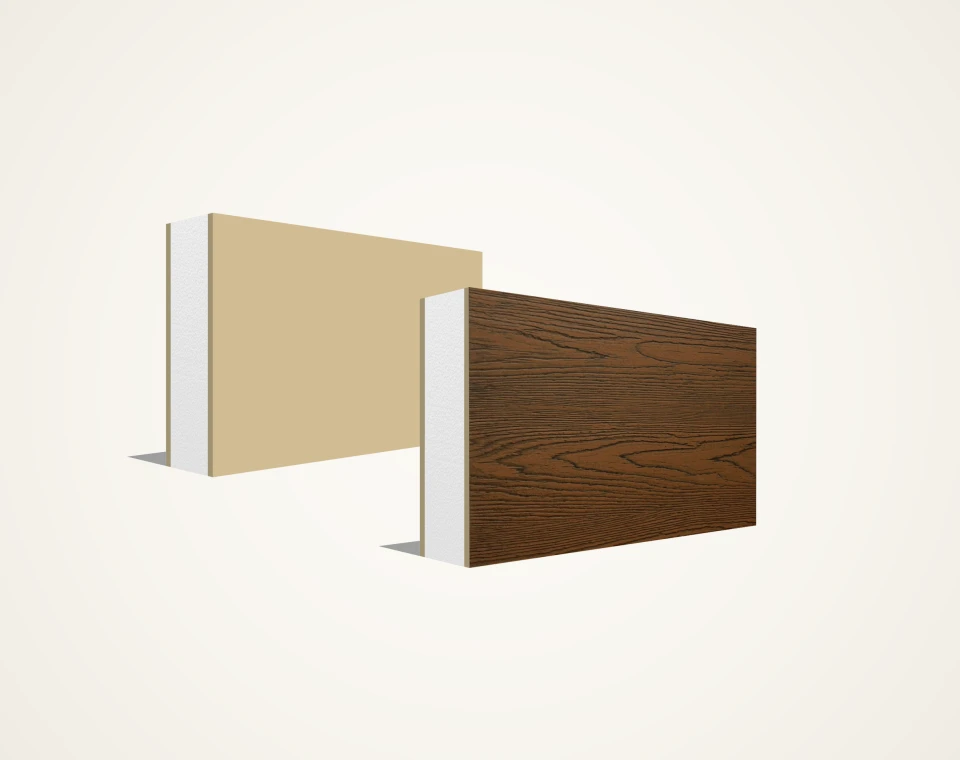
Three-layer ready-made wall panels combining 8 + 8 mm autoclaved Class A1 fibre cement skins with a 16 DNS EPS thermal core across 60, 80 and 100 mm thicknesses in smooth and 5 embossed reliefs.
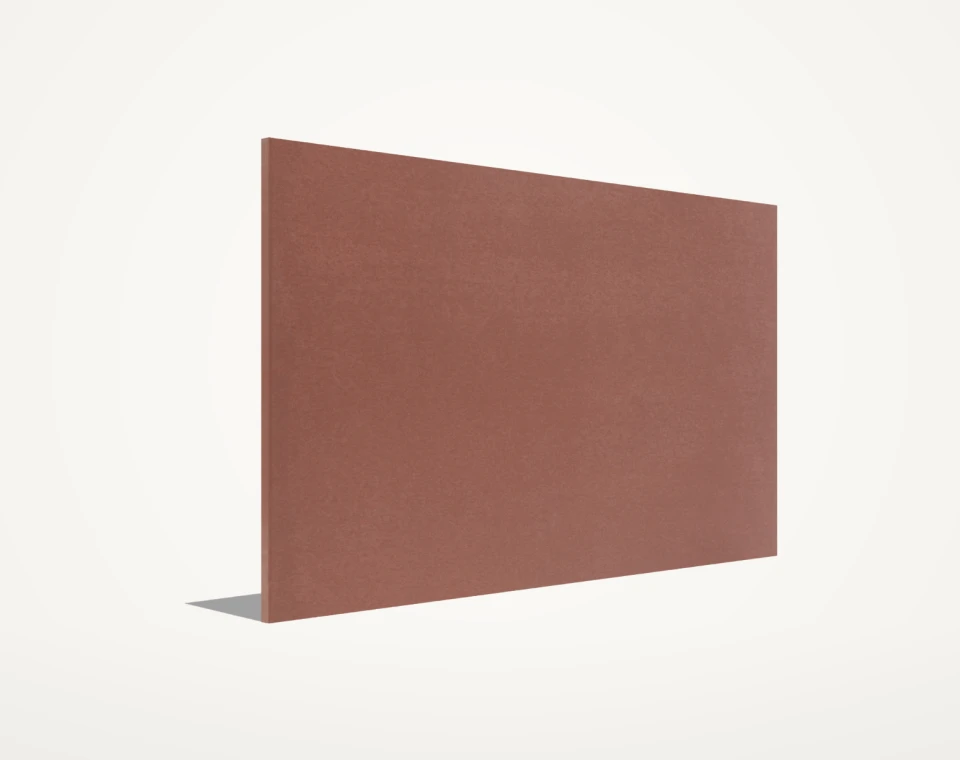
Autoclaved 1250 × 2500 × 10 mm mass-pigmented flat facade board (EN 12467+A2 Cat. A, Class A1, RL ≥ 0.75) requiring zero site painting across 7 core shades and 5 solution topcoats.
Frequently Asked Technical & Commercial Questions
Why are flat fibre cement boards exported in 20' containers instead of 40' containers?
Dense mineral boards hit the maximum legal payload weight (24–27.5 tonnes) while filling less than half of a 20' container’s volume. Booking a 40' container adds higher ocean freight and container tare weight without granting extra weight capacity.
Approximately how many m² of 8 mm or 10 mm boards load into one 20' container or truck?
Depending on series density, pallet tare and destination road weight limits (22–26 tonnes), a full load typically carries roughly 1,400–1,800 m² in 10 mm or 1,800–2,200 m² in 8 mm. Exact full-pallet counts are confirmed on your proforma load plan.
When does a 40' High Cube (40' HC) container make sense for SerFibro shipments?
When exporting lightweight EPS-insulated SF-PANEL ready-wall composite panels (60, 80 or 100 mm thick at ~23.5–25.0 kg/m²), where stack height fills cubic container volume well before reaching maximum payload tonnage.
Why are 13.60 m curtainsider trucks preferred over 20' containers for 1250 × 3000 mm boards?
A 20' container has ~5.89 m internal length, so two 3000 mm pallets cannot fit end-to-end on the floor, whereas a 13.60 m curtainsider accommodates four 3000 mm bays cleanly and allows rapid side-forklift unloading.
Can pallet weights be capped if our jobsite forklift lifts a maximum of 1,500 kg?
Yes. Declare your maximum forklift lifting capacity and fork length before order confirmation via WhatsApp (+90 505 507 04 18) or [email protected] so sheet counts per ISPM-15 pallet are split within your safe unloading limit.
Ready to Verify Formats, Finishes & Export Delivery Terms?
Share your target board thickness, outer dimensions, finish state, and destination port. Our commercial office prepares a product-matched quotation and sample dispatch plan.