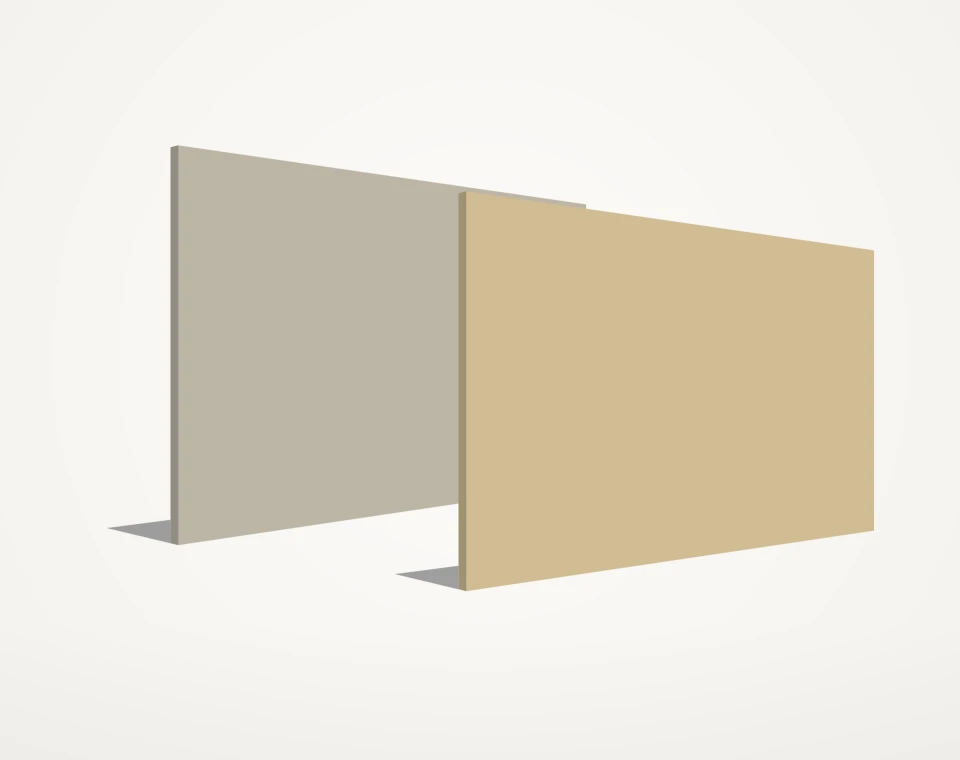
SerFibro Smooth — Flat Autoclaved Fibre Cement Boards (Interior & Exterior)
Flat, calm architectural mineral boards supplied raw, factory-primed or coated for ventilated facades, light-steel assemblies and interior linings.
Concise, engineering-verified answers organized across commercial scope, dimensional arithmetic, surface finishes, export palletising, and technical documentation.
SerFibro operates under CFY Engineering & Architecture in Istanbul as a specialized B2B fibre cement board and facade panel supplier from Türkiye. Rather than claiming factory ownership, we match project and wholesale enquiries to verified Turkish production lines, share product-specific technical datasheets, and coordinate export packing and dispatch.
Yes. Alongside domestic and export fibre cement board supply, our multidisciplinary CFY Engineering & Architecture team provides project design, architectural consultancy, facade engineering, sub-framing coordination (including galvanized light-steel profiles via our group brand SerProfil), and professional cladding application services tailored to project scope.
Minimum order volume depends on whether you select an uncoated standard sheet format (such as 1250 × 2500 mm), a patterned relief mould, or a custom factory-coated colour batch. Export shipments are typically structured around full pallets, full road trucks, or 20ft containers to ensure safe transport economics.
Our quote, sample, and estimator forms compile your selected product families, candidate formats, thicknesses, quantities, and delivery destination directly into a structured WhatsApp message to +90 505 507 04 18 without server-side upload delays. Once the chat opens, you can attach PDF elevations or Excel schedules directly—or email large CAD packages to [email protected].
In B2B fibre cement trade, landed unit cost varies substantially with thickness (6 mm to 16 mm), surface state (uncoated vs factory-coated vs through-coloured), pallet weight utilisation, Incoterm basis (EXW, FCA, FOB, CIF, DAP), and destination port. Quoting per verified specification avoids misleading placeholder figures.
Cevizli Mah. Orhan Gazi Cad. No: 24/B Maltepe / Istanbul is our Commercial & Engineering Head Office for meetings, sample inspection, and contract coordination. Actual pallet loading warehouse or Turkish export port (Istanbul, Kocaeli, Gemlik, Izmir, or Mersin) is confirmed according to the selected product line and Incoterm.
Yes. The gallery showcases architectural facade combinations across our Self-Coloured (ColorBoard) and Paintable (SerFibro Board) series. Depending on your project location and needs, you may request standalone B2B/export material supply or an integrated scope covering architectural modulation, facade engineering, and professional installation.
For flat and wood/concrete/colour architectural boards, 1250 × 2500 mm (3.125 m²) and 1250 × 3000 mm (3.75 m²) are the primary enquiry formats. Brick-relief panels frequently use pattern-matched outer sheets such as 1225 × 2590 mm or 1225 × 3000 mm, while horizontal lap cladding planks are commonly requested in 170 / 200 mm widths by 2500 / 3000 mm lengths. Exact availability is confirmed per order.
Nominal outer size describes the delivered rectangular sheet (e.g. 1250 × 2500 mm). When cutting architectural facade cassettes, perimeter edge squaring trims (often 10–15 mm per edge on raw boards), saw blade kerf (3–4 mm per cut), and directional grain constraints reduce net yield. Always verify whether your facade grid requires factory-squared edges.
Lap cladding planks overlap horizontally to shed rainwater. For example, a 200 × 2500 mm plank has a geometric outer area of 0.50 m², but when installed with a 30 mm horizontal overlap its visible effective width is 170 mm (0.425 m² effective coverage per plank)—requiring roughly 17.6% more planks than raw outer m² before cutting waste.
In dry interior linings and infill partitions, 6 mm, 8 mm, and 10 mm smooth boards are frequently evaluated. For exterior ventilated rainscreen facades, 8 mm, 10 mm, and 12 mm boards are common candidates, while deep-relief stone/brick/linear panels often require 10 mm or 12 mm to maintain sufficient residual core thickness. Final thickness must always be verified by the project structural/facade engineer.
Alongside full-sheet factory supply, SerFibro offers a structured B2B Cut-to-Size & Facade Module Preparation service subject to MOQ. Orders must meet full master-sheet pallet multiples with repeatable rectangular module schedules (excluding retail or single-piece cutting) and can include pose/elevation-coded palletising as well as project-evaluated CNC pre-drilling, chamfering, and cut-edge sealing.
Industrial beam-saw and CNC calibration, perimeter squaring trim (~10–15 mm per edge), and custom export pallet framing require commercial batch scale. Therefore, cut-to-size MOQ is defined by full master-sheet pallet multiples (1250 × 2500 / 2800 / 3000 mm or 1225 × 2590 / 3000 mm) combined with repeatable rectangular facade module schedules. Retail, DIY, or single-sheet custom cuts are not accepted.
Yes, as separately quoted project-based machining lines when approved DXF shop drawings are supplied. CNC pre-drilling distinguishes fixed-point and sliding-point holes per substructure thermal expansion rules. For cut edges, through-coloured SerFibro ColorBoard (10 mm) exposes its pigmented core and can receive clear hydrophobic impregnation, whereas natural/coated SerFibro Board exposes its mineral grey core and can be quoted with compatible edge sealer or touch-up.
Commercial quotations transparently separate material and processing: material is billed based on the total full master-sheet pallets consumed by the approved nesting layout (accounting for ~10–15 mm perimeter trim, ~3–4 mm PCD saw kerf, and grain/sanding direction lock), while sizing, CNC operations, pose/axis labeling, and ISPM 15 custom palletising are itemised separately. Usable rectangular offcuts can be packed on request if agreed prior to cutting.
Factory-coated panels feature an opaque or semi-transparent architectural paint system applied onto a natural mineral grey fibre cement core; saw-cut edges expose the grey core and require compatible edge sealing. Through-coloured panels incorporate mineral pigments throughout the entire board matrix so face and cut edges share the same colour family, typically finished with a matte hydrophobic or translucent protective coat.
Yes, provided boards are dry, clean, dust-free, and coated with an alkali-resistant mineral/acrylic primer followed by a breathable exterior facade paint recommended for fibre cement substrates. Ordering pre-primed boards reduces site preparation risk and improves topcoat uniformity.
Woodgrain (TX-WD), coursed stone (TX-ST), brick (TX-BR), linear ribs (TX-LN), and sanded matte boards (TX-SD) interact directionally with daylight. Rotating one panel by 90° or 180° on a facade elevation creates visible shade differences even within the same production batch.
Yes. Because fibre cement is manufactured from natural mineral raw materials (cement, silica, mineral fillers, and cellulose/reinforcing fibres), subtle clouding and lot-to-lot tonal character are part of authentic mineral surfaces. For continuous architectural elevations, order the complete elevation quantity in a single production lot.
Screen swatches provide initial palette orientation only. Standard factory-coated shades and project-specific RAL/NCS coating enquiries are always confirmed against physical hand samples and minimum coating batch thresholds before proforma invoice approval.
Self-Coloured ColorBoard sheets (10 mm) are pigmented throughout their mineral core so cut edges match the face without site painting. Paintable SerFibro Board sheets & 20 mm profiles (6–20 mm) are supplied natural grey or primed for custom RAL coatings. SerFibro Panel (60, 80, 100 mm) is a 3-layer composite ready-wall element bonding 8 + 8 mm Class A1 fibre cement skins onto a 16 DNS EPS core (or MOQ Rockwool/XPS/PUR) in smooth and 5 embossed reliefs.
Depending on transport mode (road curtain-sider truck, intermodal trailer, or 20ft sea container) and destination country, quotations can be prepared on EXW, FCA, FOB (Turkish port), CFR/CIF, or CPT/DAP basis. Exact Incoterm and named place are stated clearly on every quotation.
Payload weight is almost always the governing limit. Because mineral fibre cement boards are dense, both road trucks and 20ft containers reach maximum legal gross payload well before their cubic volume is full. Accurate thickness and sheet count are therefore essential to calculate freight cost per m².
Boards are stacked horizontally on flat rigid wooden pallets (ISPM 15 heat-treated timber for export where required), fitted with protective edge/corner guards, interleaved where coated surfaces require separation, wrapped in moisture-resistant hood/film, and secured with tension strapping.
Unload pallets on level firm ground using wide-fork forklifts or spreader-bar slings that never crush board edges. Store pallets indoors or under ventilated dry cover; never leave shrink-wrapped pallets in direct rain/sun (condensation staining risk), and always carry individual sheets vertically on edge with two operators.
Standard export documentation prepared according to destination country and transport mode includes Commercial Invoice, Packing List (with net/gross weights and pallet counts), CMR or Bill of Lading (B/L), Turkish Export Customs Declaration, and A.TR or Certificate of Origin / EUR.1 where applicable.
Physical density, bending strength class, moisture movement, and reaction-to-fire classification depend on the exact board formulation and factory coating build-up (e.g. uncoated mineral board vs multi-coat painted panel). Sharing variant-matched documents guarantees that your specification engineer reviews authentic test parameters.
EN 12467 classifies flat fibre cement sheets by exposure category (A, B, C, D—where Category A targets external weather-exposed applications) and bending strength class (Classes 1 to 5). State your required exposure category and thickness in your enquiry so we match a compliant board series and supply its verified datasheet.
Yes. Under EN 13501-1, organic paint thickness and calorific value can differentiate an uncoated mineral substrate from a factory-coated panel, and board reaction-to-fire (e.g. A1 / A2-s1,d0 per datasheet) must never be confused with complete wall fire resistance (EI 30 / EI 60), which tests the entire wall assembly.
Sample dispatches contain cut hand-specimens (commonly ~150 × 200 mm or ~200 × 300 mm) showing true core cross-section, relief depth, and surface finish state, labelled with reference codes. Qualified architectural practices, contractors, and importers can request samples directly via our Sample page or WhatsApp desk.
Outer skins and core are stated transparently: both 8 + 8 mm autoclaved natural fibre cement skins are EN 13501-1 Class A1 non-combustible mineral boards, whereas the thermal core is 16 DNS EPS foam. Where a fully non-combustible core is required by fire code, Class A1 Stone Wool (Rockwool) core lamination is evaluated subject to project MOQ.
Flat, calm architectural mineral boards supplied raw, factory-primed or coated for ventilated facades, light-steel assemblies and interior linings.
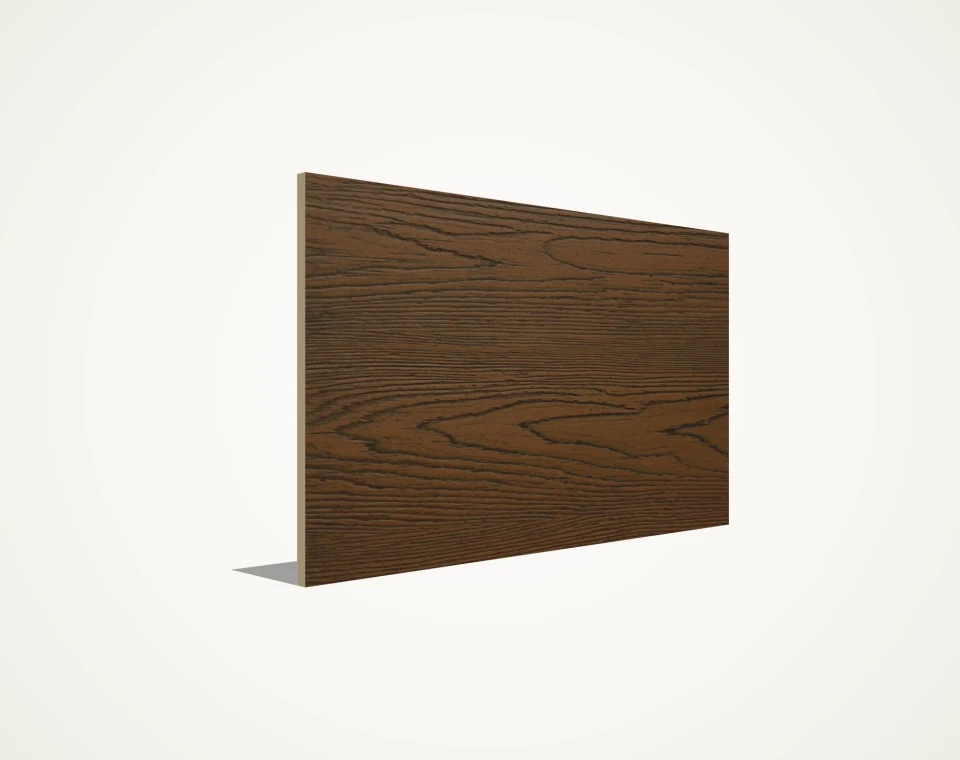
Full-format mineral boards embossed with directional walnut or cedar timber grain for ventilated facades, modular housing and commercial elevations.
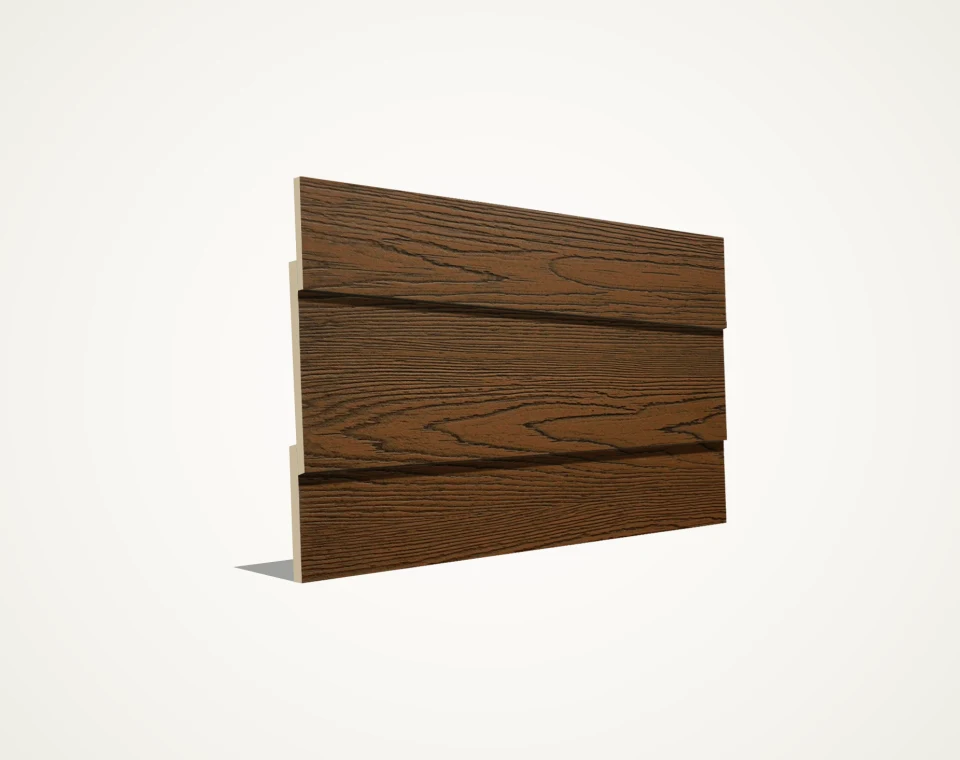
Weatherboard cladding planks (170 / 200 mm outer width, 8–10 mm) in wood-grain or smooth finishes for horizontal lap-joint facades and light-steel prefab homes.